

Bonds are often treated as the default defensive allocation. In many portfolios, that means broad aggregate bond exposure: diversified, familiar, and relatively stable. But stability is not the same thing as regime protection.
A regime-aware portfolio needs to ask a more specific question: what kind of environment is the defensive sleeve supposed to respond to? Inflation shock, deflation shock, falling growth, rising real yields, currency debasement, and liquidity stress are not the same problem.
Traditional bonds are stable, but not precise
The goal is not to declare aggregate bonds useless. The goal is to recognize that a blended bond fund and a macro convexity sleeve are solving different portfolio problems.
The problem with traditional bonds
Aggregate bond funds can play a useful role. They dampen volatility, generate income, and provide a familiar anchor for conservative portfolios. But their structure is inherently blended. They typically include intermediate-duration government bonds, agency debt, mortgage-backed securities, and corporate credit.[5]
That structure makes sense for stability, but it also limits precision. Aggregate bonds are not pure duration, not pure cash, not pure credit, and not an inflation hedge. They are a diversified bond allocation. That can be useful, but it is not the same thing as a targeted macro response sleeve.
This distinction matters most during regime breaks. In a falling-rate recession, long-duration Treasuries may provide stronger convexity than aggregate bonds. In an inflationary or currency-stress regime, gold may provide better protection than nominal bonds. In a rapid real-yield shock, even both gold and long duration can struggle, which is why real-yield monitoring matters.
Why split the hedge?
Instead of asking one bond fund to hedge every environment, the macro convexity framework separates the problem into two cleaner exposures:
- Gold for inflationary pressure, currency debasement, and monetary instability.
- 25+ year zero coupon U.S. Treasuries for deflationary shocks, falling-rate environments, and growth scares.
This is not a low-volatility sleeve. It is a high-convexity sleeve. The goal is to own assets that can respond aggressively when the macro environment changes, then rebalance across those regime-sensitive moves.
A hedge does not have to be smooth to be useful
A smoother asset is not automatically a better hedge. For a long-term, equity-led portfolio, the more important question is whether the defensive sleeve changes portfolio behavior when the environment changes.
Gold as the inflation leg
Gold is not a traditional compounding asset. It does not produce cash flows, and it can spend long periods moving sideways. That is the cost of holding it.
Its role is different: gold is a monetary asset. It tends to matter most when investors are questioning purchasing power, currency stability, fiscal credibility, or the future path of real rates. Commodity and gold indices provide one way to observe these regime-sensitive price moves over time.[4]
In a macro convexity sleeve, gold is not held because it is always attractive. It is held because it responds to a different set of risks than nominal Treasuries. That difference is the point.
Zero coupon Treasuries as the deflation leg
Long-duration zero coupon Treasuries sit at the opposite end of the macro hedge spectrum. They are highly sensitive to changes in interest rates because most of their value is tied to a distant future payment rather than near-term coupons.
That makes them volatile, but also highly convex. When rates fall sharply during recessionary or deflationary shocks, long-duration Treasuries can rise meaningfully. Treasury yield data and real-yield data are central to understanding this relationship.[2–3]
This also explains why the entry point matters so much. Long-duration Treasuries benefited enormously from the multi-decade decline in rates from the early 1980s through the post-GFC and COVID eras. That historical tailwind should not be blindly extrapolated.
Why the pairing matters
Gold and long-duration Treasuries are individually unreliable. Gold can have long dead periods. Long-duration Treasuries can suffer large drawdowns when rates rise. But together, they cover more macro terrain than either does alone.
A useful way to think about this is not “which asset is better,” but “which asset responds to which problem.”
| Environment | Gold | 25+ Year Zero Coupon Treasuries | Combined sleeve |
|---|---|---|---|
| Inflation / currency pressure | Strong potential | Weak | Gold carries the sleeve |
| Deflation / recession | Mixed | Strong potential | Duration carries the sleeve |
| Regime transition | Variable | Variable | Rebalancing can matter |
| Rapid real-yield increase | Often pressured | Often pressured | Known weak spot |
The pairing is not designed to win every year. It is designed to avoid relying on a single macro assumption. Gold and duration each fail in different ways, but their failure modes are often different enough to make the combined sleeve more useful than either asset in isolation.
What the backtests actually show
The data does not show a consistent winner. It shows consistent rotation. Each of the following environments highlights a different macro regime. The goal is not to identify the best individual asset, but to show why a paired hedge can be more useful than relying on one defensive exposure to solve every problem.
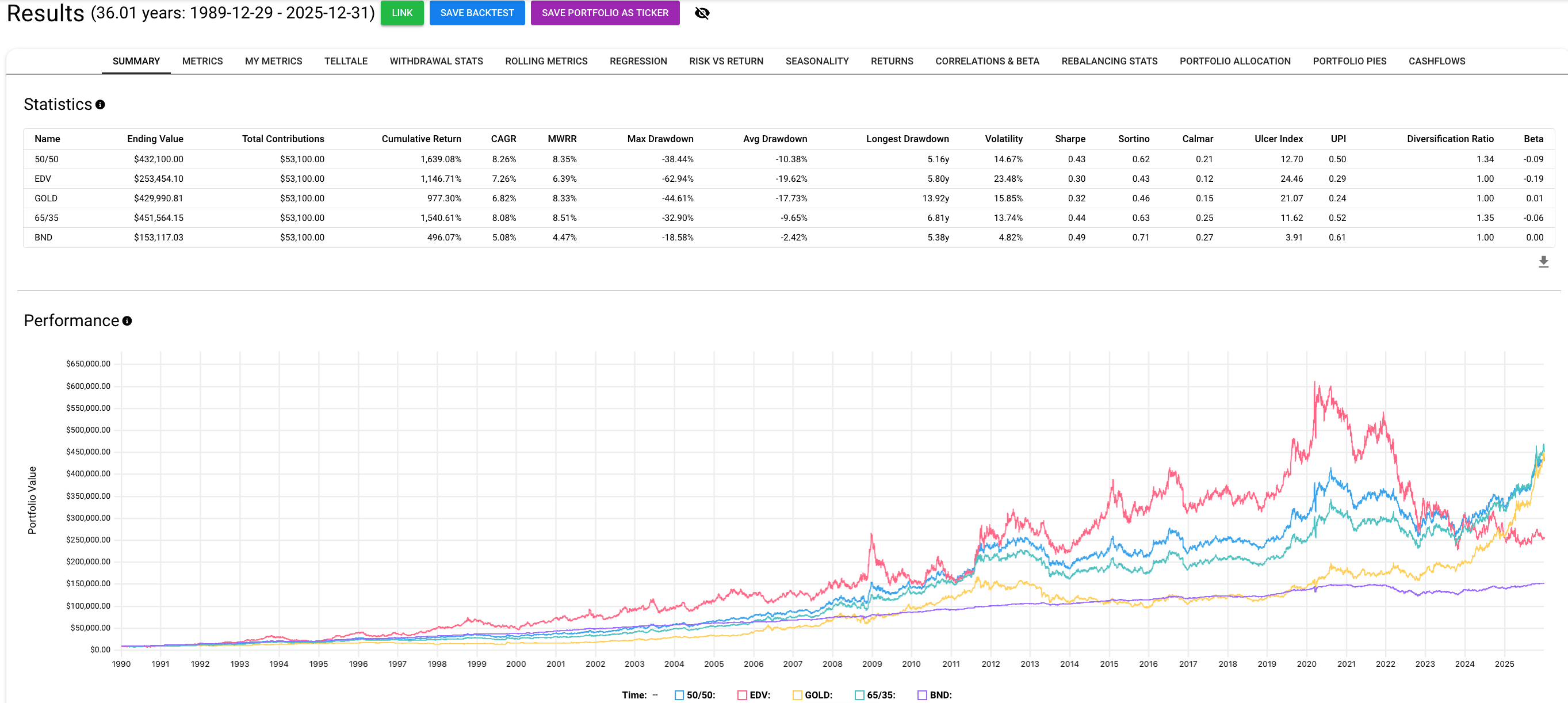
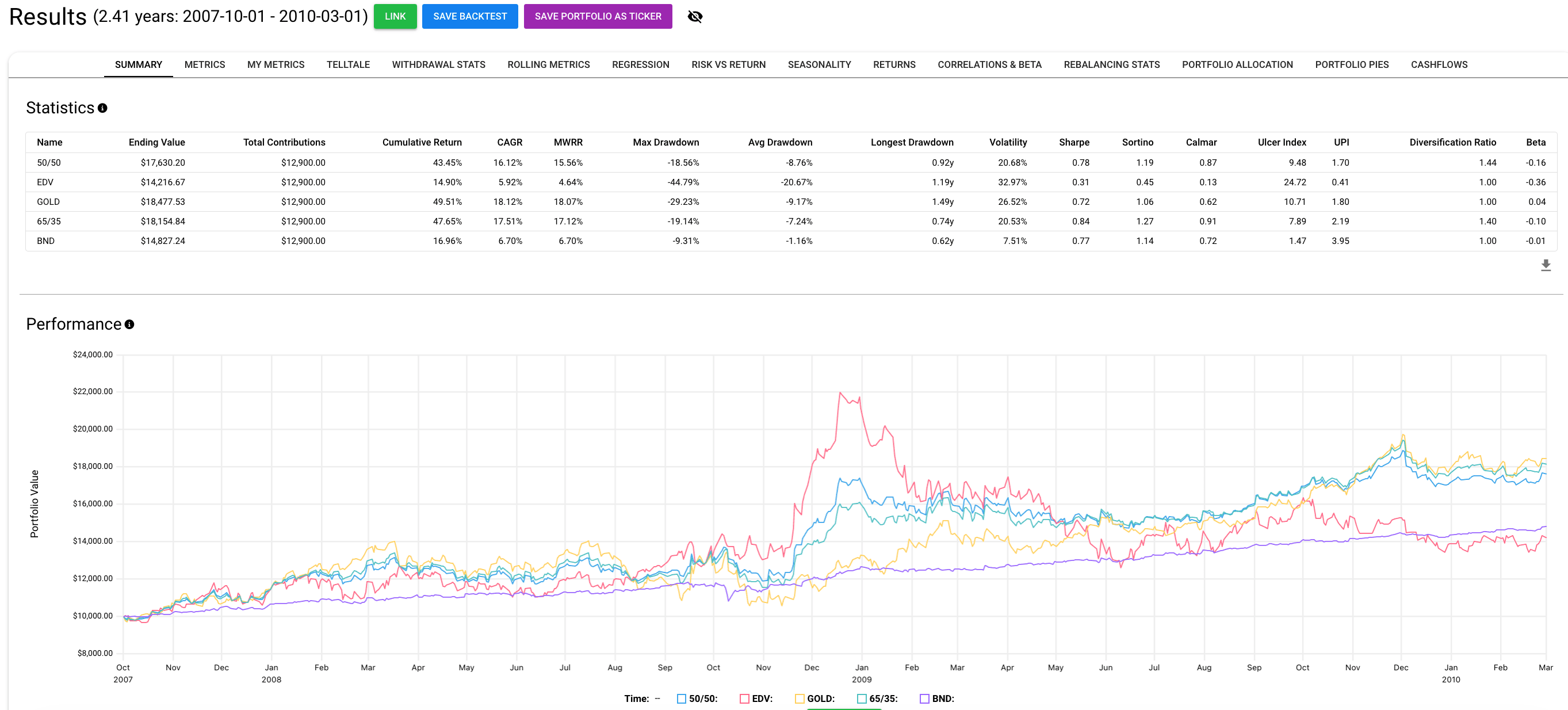
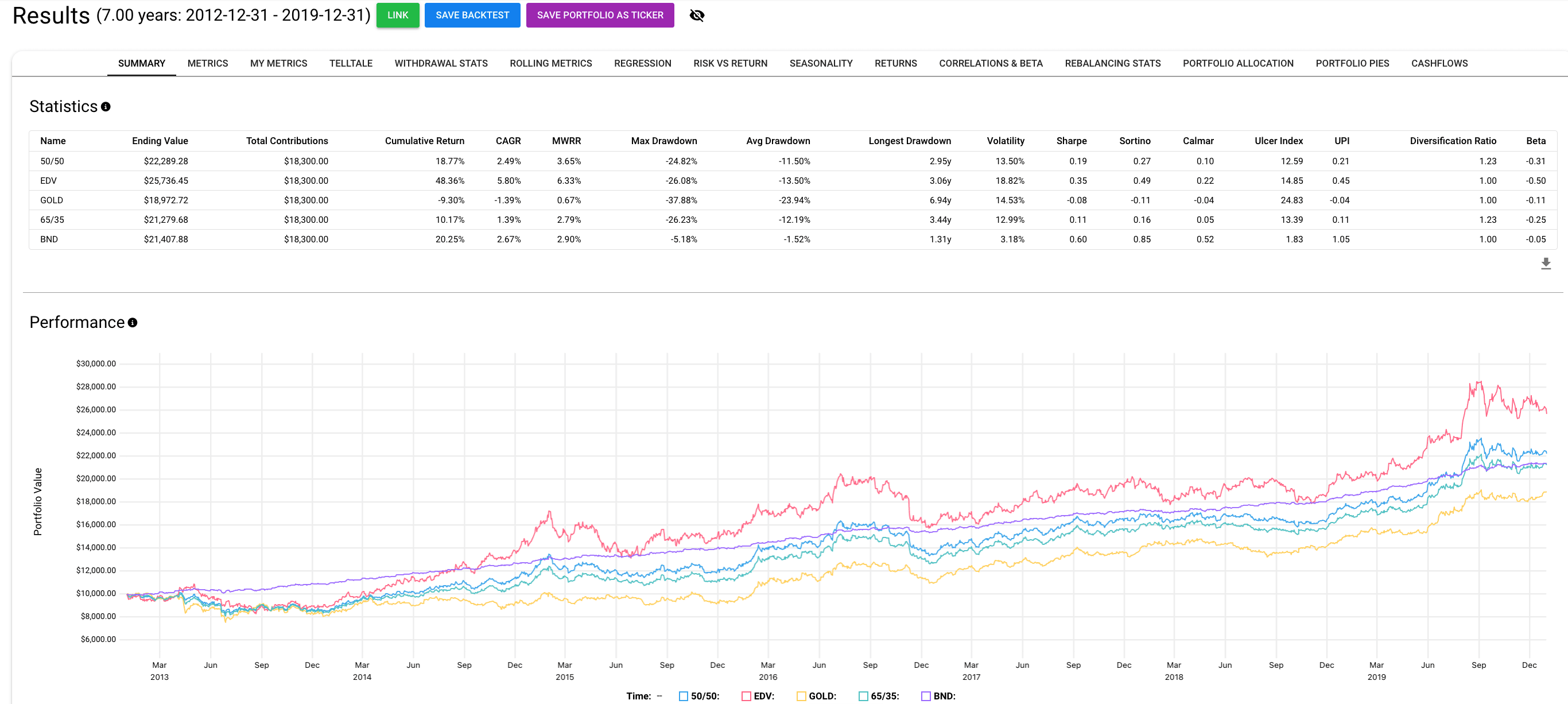
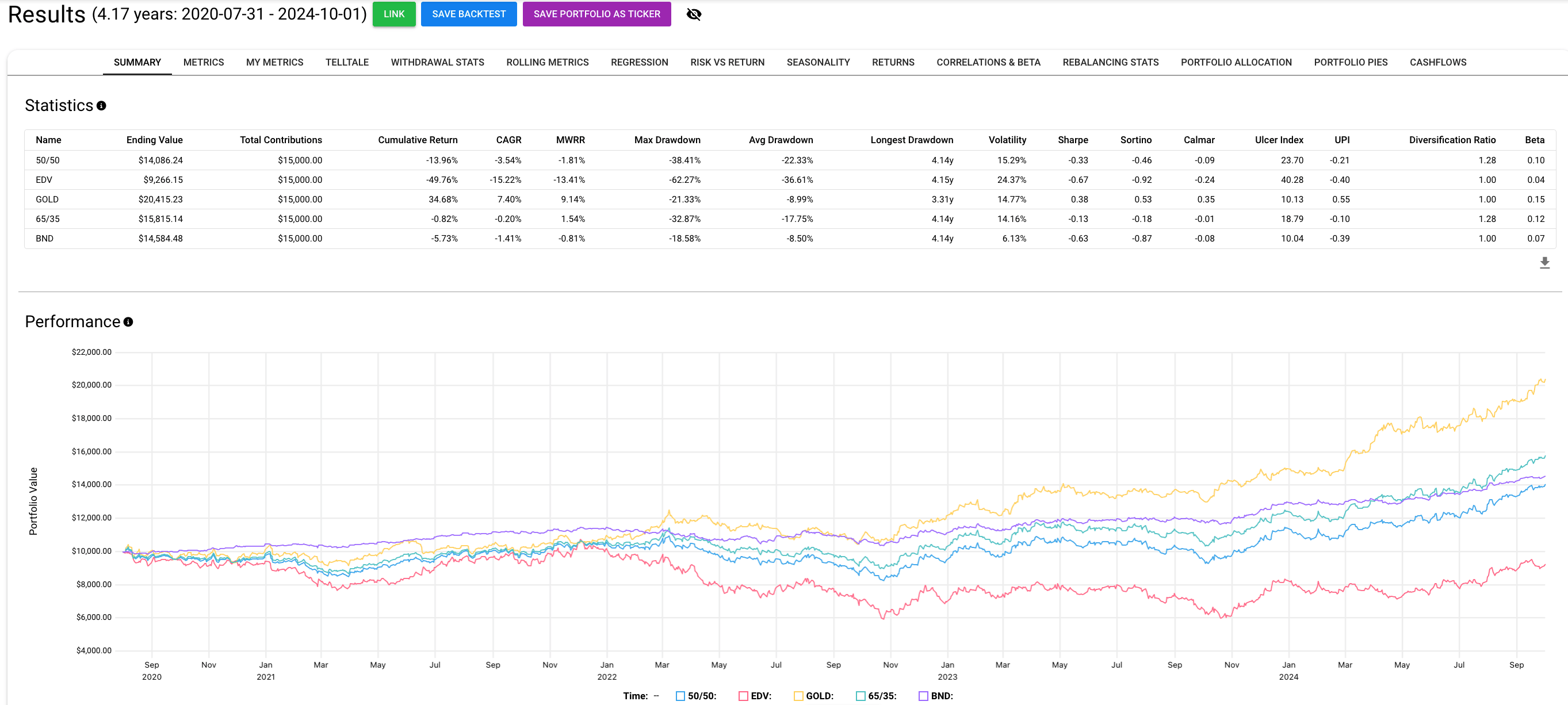
The takeaway is not that any one asset is superior. It is that different environments reward different hedges. A single blended bond allocation cannot express this behavior cleanly.
The objective is not to beat BND every year
A traditional bond fund may be easier to hold in a one-year shock. A macro convexity sleeve may be more useful across a multi-decade, equity-led portfolio lifecycle.
The goal is not prediction
A macro convexity sleeve works not because it always wins, but because it reduces dependence on being right about the future.
The real-yield blind spot
The main weakness of the pairing is rising real yields. This is the environment where both gold and long-duration Treasuries can struggle at the same time. Long-duration Treasuries are directly pressured by rising rates. Gold can also be pressured when real yields rise because the opportunity cost of holding a non-yielding asset increases.[2]
This does not invalidate the sleeve. It defines the guardrail. Real yields should be treated as a primary monitoring variable when deciding whether to lean toward gold, lean toward duration, or remain balanced.
- Rising real yields: avoid increasing duration exposure.
- Falling real yields: duration becomes more attractive.
- Inflation pressure with unstable real rates: gold-heavy tilts may be more appropriate.
How ARC can use the sleeve
In ARC, the macro convexity sleeve is not the primary return engine. Equities remain the core compounding engine by design. The role of the macro sleeve is to change portfolio behavior when the world changes.
A neutral version of the sleeve may use an even split between gold and long-duration Treasuries. In a more inflationary regime, the sleeve can tilt more heavily toward gold. In a deflationary or recessionary rate-cutting regime, the sleeve can tilt back toward duration.
The important constraint is that the adjustment remains sleeve-contained. The portfolio is not rebuilt every time the macro view changes. The equity engine stays intact, while the macro sleeve adjusts its internal balance.
Limitations
- Gold can experience long flat periods and does not generate cash flow.
- Long-duration zero coupon Treasuries are extremely sensitive to rate changes.
- Both legs can struggle when real yields rise quickly.
- The pairing introduces more short-term volatility than traditional bond exposure.
- Historical bond returns benefited from a multi-decade decline in interest rates.
- Rebalancing discipline is required for the pairing to work as intended.
The sleeve should not be treated as a free lunch. It is better understood as a deliberately volatile, regime-aware diversifier that can improve total portfolio behavior when sized appropriately.
Next steps
Sources & References
- [1] Fama, E. & French, K. (1993). Common risk factors in the returns on stocks and bonds. Journal of Financial Economics.
- [2] Federal Reserve Economic Data — Market Yield on U.S. Treasury Securities at 10-Year Constant Maturity, Inflation-Indexed.
- [3] U.S. Department of the Treasury — Daily Treasury Par Yield Curve Rates.
- [4] S&P Dow Jones Indices — S&P GSCI Gold and commodity index research.
- [5] Vanguard — Total Bond Market ETF overview and portfolio characteristics.
Gold and long-duration Treasuries can form a more regime-aware hedge sleeve than traditional aggregate bond exposure.
Gold provides exposure to inflationary pressure, monetary instability, and currency-debasement risk.
Long-duration zero coupon Treasuries provide convexity during falling-rate, recessionary, or deflationary shocks.
The sleeve should be sized modestly, rebalanced consistently, and monitored through real-yield conditions.
Portfolio Engineers publishes rules-based, regime-aware portfolio research for education. We prioritize observable data series, explicit guardrails, and behaviorally sustainable processes over prediction.